
Choosing the right Led Tunnel Light begins with safety, visibility, and operating conditions, not product appearance. A tunnel roof can look evenly illuminated while drivers still face glare, flicker, or dark patches. That difference matters during rain, dust, and sudden daylight changes.
The International Energy Agency reports that lighting represents roughly 15% of global electricity consumption. This explains the growing interest in LED upgrades, especially where tunnels operate continuously. The U.S. Department of Energy has also documented major LED gains in efficacy, controllability, and service life. However, energy savings alone cannot prove a successful installation. CIE 88:2019 and the PIARC Road Tunnels Manual emphasize adaptation zones, threshold lighting, interior lighting, exit areas, and maintenance planning. These requirements shape the ten product types discussed in this guide, including linear tunnel fixtures, high-output luminaires, emergency lights, and smart dimming systems.
Lighting researcher Peter R. Boyce states, “The purpose of lighting is to enable people to see.” That simple principle remains useful here. A powerful Led Tunnel Light can still fail when its beam creates reflections on wet pavement. A cheaper fixture may also become expensive after repeated cleaning and replacement. We should admit one limitation: published efficiency figures rarely reflect every tunnel’s dust, traffic speed, ceiling height, or control strategy. Therefore, global buyers need more than a catalog comparison. They need photometric files, tested glare data, thermal performance, ingress protection, driver reliability, and evidence from comparable projects. The following ten types provide a practical starting point, though no universal ranking fits every tunnel.
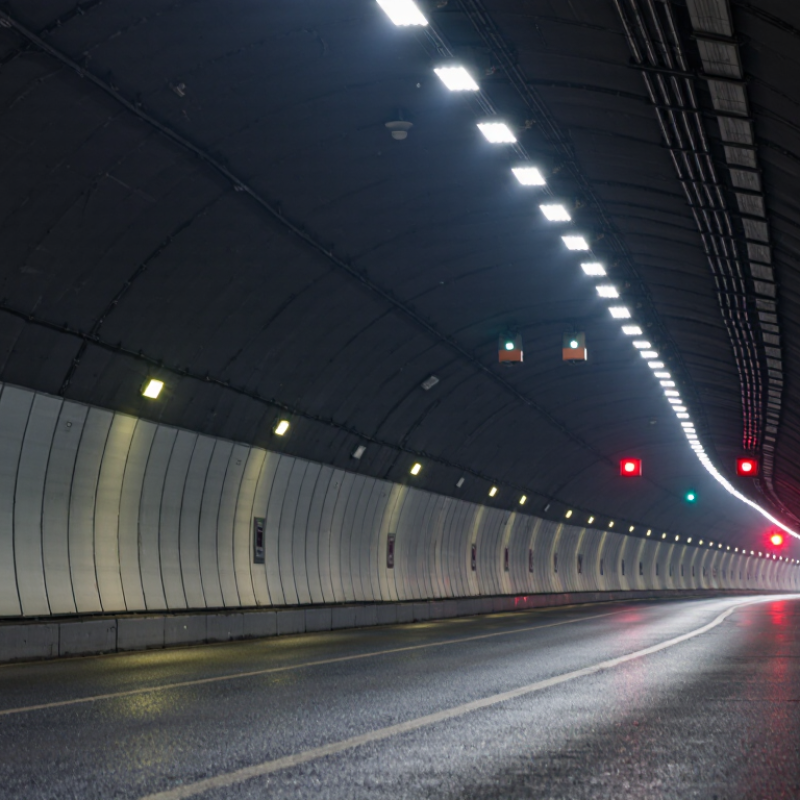
An LED tunnel light is a purpose-built roadway luminaire for confined, demanding environments. It must provide stable illumination, manage heat, and resist dust, moisture, vibration, and exhaust residue. Unlike ordinary outdoor fixtures, tunnel lights support driver visibility during sudden changes from daylight to darkness.
The main types differ by optical distribution and installation position. Symmetric lights spread illumination evenly across the road. Asymmetric lights direct more output toward one side, helping reduce dark walls and uneven pavement brightness. Counter-beam lights project light against the traffic direction, improving object contrast near tunnel entrances. Pro-beam designs aim with traffic flow and can support entrance zones, where daylight creates severe visual adaptation problems. Continuous linear lights create an uninterrupted guide along the ceiling. Point-source luminaires offer easier replacement and flexible spacing. Low-profile models suit tunnels with limited clearance. High-output threshold fixtures handle bright entrance areas. Interior-zone lights use lower output after drivers adapt. Emergency-compatible units maintain essential visibility during power interruptions.
Details matter. Beam angle, mounting height, spacing, glare control, and dimming response should be checked together. A powerful fixture can still produce poor visibility when its optics are mismatched. Wide beams may brighten walls but waste energy on empty ceiling space. Narrow beams can create bright patches between dark areas. Not always obvious. Reliable selection also requires verified photometric data, suitable ingress protection, thermal testing, and compliance with local road-lighting requirements. Field assessments often reveal a practical weakness: maintenance access was considered too late. A tunnel light is only effective when operators can inspect, clean, and replace it safely.
Top 10 Types of LED Tunnel Lights for Global Buyers
Ten LED Tunnel Light Types Classified by Structure, Optics, and Application
Tunnel lighting becomes clearer when buyers classify products by structure, optics, and application. The ten practical types include recessed linear, surface-mounted linear, suspended linear, modular, and high-output flood fixtures. They also include symmetric, asymmetric, narrow-beam, wide-beam, and adaptive-control systems. These categories can overlap. That overlap matters.
Recessed linear lights create a clean ceiling line and reduce exposed hardware. Surface-mounted linear models suit retrofit projects with limited structural access. Suspended fixtures help illuminate high ceilings and difficult maintenance zones. Modular units simplify replacement when one section fails. High-output flood lights support tunnel entrances, ramps, and broad transition areas. They need careful glare control.
Symmetric optics distribute light evenly across the roadway. Asymmetric optics direct more light toward walls or driving lanes. Narrow beams can highlight entrance zones, while wide beams reduce dark gaps between fittings. Adaptive-control systems adjust output according to traffic, daylight, or tunnel sections. Field inspections often reveal uneven spacing, poor heat management, or confusing photometric data. A catalog can look convincing.
Global buyers should review beam files, lumen maintenance, ingress protection, impact resistance, color temperature, and driver performance. Check the actual mounting height. Also inspect access for cleaning and replacement. I have found that the cheapest fixture is rarely the cheapest installation. Yet premium specifications can also be unnecessary when the tunnel geometry is simple. A real project calculation should decide.
Top 10 Types of LED Tunnel Lights for Global Buyers
Tunnel length changes the lighting strategy. A short tunnel may need entrance, interior, emergency, and exit luminaires. A long tunnel usually requires separate threshold, transition, and interior zones. CIE 88:2004 links threshold lighting to outside luminance, approach speed, and stopping distance. The FHWA Tunnel Lighting Handbook also stresses uniformity, glare control, and driver adaptation. Light levels cannot be selected by tunnel length alone.
Traffic flow adds another variable. Heavy daytime traffic increases visual demand and maintenance pressure. Night traffic may allow deeper dimming, but only with reliable controls. A 2023 U.S. Department of Energy SSL report recorded laboratory LED efficacy above 200 lumens per watt. Installed tunnel fixtures perform lower because optics, heat, dirt, and drivers reduce output. That gap matters.
Visibility decides the final package. High-output entrance lights support dark adaptation zones. Linear interior lights reduce shadow gaps. Low-mounted units can improve wall and pavement guidance. Emergency and evacuation luminaires must remain visible during power interruptions. Dimmable, sensor-ready, and corrosion-resistant models suit different tunnel conditions. PIARC’s Road Tunnels Manual emphasizes maintenance, safety, and visual continuity across zones.
Field audits often reveal over-lit entrances and under-lit transitions. A perfect specification is rare. Buyers should request photometric files, maintenance factors, temperature ratings, and control compatibility. Tunnel length starts the conversation. Traffic flow and visibility finish it.
| No. | LED Tunnel Light Type | Typical Optical Distribution | Best Tunnel Application | Traffic and Length Profile | Typical Power Range per Luminaire | Recommended Visibility Features | Buyer Selection Notes |
|---|---|---|---|---|---|---|---|
| 1 | Symmetric Wide-Beam LED Tunnel Light | Broad, balanced beam with wider lateral coverage; commonly used for general roadway uniformity. | Standard interior zones, straight sections, and tunnels with regular luminaire spacing. | Low-to-medium traffic; short, medium, or long tunnels where the mounting height and spacing are moderate. | 60–180 W | Uniform luminance, low glare, CRI typically 70 or higher, and stable color consistency. | Choose when uniform road coverage is more important than long throw distance. Confirm spacing through a photometric design. |
| 2 | Symmetric Narrow-Beam LED Tunnel Light | Narrower forward and lateral distribution that concentrates light on the carriageway. | High mounting positions, narrow roadways, and long interior zones requiring longer optical reach. | Medium-to-high traffic; medium or long tunnels with larger spacing between fixtures. | 90–240 W | High maintained illuminance, controlled spill light, and reduced dark gaps between luminaires. | Useful where fixtures are mounted farther apart, but glare and uniformity must be checked carefully. |
| 3 | Counter-Beam LED Entrance Light | Light is directed generally toward approaching drivers to improve the visual contrast of tunnel objects. | Threshold and entrance zones, especially where daylight adaptation creates a strong visual demand. | High traffic; medium or long tunnels with significant daylight at the portal. | 120–300 W | High luminance output, controlled glare, strong contrast, and dimming capability for changing daylight. | Requires a tunnel-zone lighting calculation. Output should be coordinated with portal luminance and traffic speed. |
| 4 | Pro-Beam LED Entrance Light | Beam is directed in the same general direction as vehicle travel, supporting direct illumination of the road ahead. | Entrance zones where pavement and wall brightness must be increased while limiting direct view of the LED source. | Medium-to-high traffic; portals exposed to bright daytime conditions. | 100–280 W | Good pavement visibility, controlled veiling luminance, and adjustable output for daytime operation. | Can be considered when the lighting design prioritizes forward roadway illumination and glare management. |
| 5 | Asymmetric Wall-Wash LED Tunnel Light | Asymmetric distribution throws more light toward one side, wall, or roadway edge. | Curved tunnels, side-mounted installations, pedestrian edges, and areas with uneven wall reflectance. | Low-to-medium traffic; short or medium tunnels with side mounting or restricted ceiling space. | 40–160 W | Improved wall visibility, edge definition, reduced shadowing, and controlled upward light. | Verify the left-hand or right-hand optical orientation before ordering. Side mounting height strongly affects results. |
| 6 | High-Uniformity Linear LED Tunnel Light | Long, continuous or modular linear distribution designed to reduce bright-dark patterns. | Long straight tunnels, underpasses, and projects requiring visually continuous ceiling or wall illumination. | Medium-to-high traffic; long tunnels with frequent vehicle movement and strict uniformity targets. | 80–250 W per module or section | Low flicker, smooth luminance transitions, high longitudinal uniformity, and seamless optical joining. | Compare system length, module spacing, thermal design, and maintenance access rather than wattage alone. |
| 7 | Low-Glare LED Tunnel Light | Optical shielding and carefully controlled beam angles reduce direct LED brightness in the driver’s field of view. | Urban tunnels, congested routes, curved approaches, and locations with strict visual comfort requirements. | Medium-to-high traffic; any tunnel length where driver comfort and glare control are priorities. | 50–200 W | Low discomfort glare, suitable shielding, stable color, and smooth dimming at reduced traffic periods. | Request glare data and installation photometry. A low-glare product should still meet the required roadway luminance. |
| 8 | High-Output Heavy-Duty LED Tunnel Light | High-intensity directional or medium-width beam for demanding illumination levels. | Entrance reinforcement, high-speed roads, wide carriageways, and tunnels with high ceiling mounting. | High traffic; long tunnels, wide bores, or locations requiring higher maintained illuminance. | 180–400 W | High thermal stability, surge protection, robust heat dissipation, and reliable lumen maintenance. | Check power quality, thermal derating, driver replacement strategy, and actual delivered lumens at operating temperature. |
| 9 | Smart Dimmable LED Tunnel Light | Usually uses a controllable optical system combined with 0–10 V, DALI, or other compatible dimming interfaces. | Projects with changing daylight, variable traffic flow, energy monitoring, or centralized tunnel control. | Medium-to-high traffic; short to long tunnels with scheduled or sensor-based lighting levels. | 60–300 W | Stable dimming, low flicker, emergency override, fault reporting, and compatible control wiring. | Confirm control protocol, minimum dimming level, response time, surge protection, and behavior during communication failure. |
| 10 | Emergency and Evacuation LED Tunnel Light | Low-power, continuously available distribution for escape routes, walkways, exits, and emergency orientation. | Emergency lanes, pedestrian walkways, cross passages, evacuation routes, and backup lighting zones. | All traffic levels and tunnel lengths; normally installed as a dedicated safety layer. | 10–60 W | High reliability, battery or central-backup compatibility, clear route visibility, and automatic emergency operation. | Specify required emergency duration, electrical architecture, testing method, ingress protection, and local life-safety compliance. |
General purchasing reference: The power ranges are typical market planning values, not guaranteed performance limits. Final selection should be based on a professional photometric calculation using tunnel length, portal luminance, design speed, traffic volume, carriageway width, mounting height, surface reflectance, maintenance factor, local standards, and the required lighting control strategy. For tunnel environments, IP65 or higher is commonly specified, while IP66 and impact-resistant housings are often preferred for demanding installations.
Top 10 Types of LED Tunnel Lights for Global Buyers
Tunnel projects commonly use ten LED formats: linear bars, modular units, floodlights, asymmetric fixtures, symmetric fixtures, canopy lights, low-profile units, high-temperature models, dimmable smart lights, and emergency-integrated fixtures. Each type serves a different road geometry. Linear bars create continuous illumination, while asymmetric optics direct light toward the lane and reduce wall glare.
Brightness should be judged by road luminance, not wattage alone. Photometric data should show luminance, uniformity, glare control, and beam distribution. A practical test checks whether drivers can see a dark vehicle near the tunnel entrance. Color temperature around 4000K often balances visibility and visual comfort. Higher color rendering can help inspections, but it may increase energy use.
Safety depends on controlled glare, stable drivers, surge protection, and reliable emergency operation. Look for suitable ingress and impact protection, plus thermal testing under local ambient temperatures. Efficiency includes LED output, driver performance, dimming response, and maintenance access. Durable housings should resist vibration, moisture, dust, and repeated temperature changes. Ask for independent laboratory reports and clear service records. In my experience, buyers sometimes compare initial wattage too quickly. That can be a costly mistake. A slightly brighter fixture is not always safer if uniformity is poor. Even careful specifications need field validation, because tunnel dust, traffic patterns, and installation height can change real performance.
Representative benchmark scores based on commonly specified commercial tunnel-light configurations. Each factor is rated from 1 to 10, with higher values indicating stronger performance.
Counter-beam and modular high-output designs generally provide the strongest illumination and efficiency. Asymmetric and batwing optics can improve safety by reducing glare and improving uniformity, while IP66-rated, surge-protected housings and L70 lifetimes of approximately 70,000–100,000 hours support long-term durability. Actual performance depends on optical design, installation height, ambient temperature, driver quality, and maintenance.
Top 10 Types of LED Tunnel Lights for Global Buyers
Global buyers should compare tunnel lights by application, not appearance alone. Ten common options include continuous linear, modular, symmetric-beam, asymmetric-beam, counter-beam, pro-beam, wall-mounted, recessed, high-output, and emergency lighting. These categories can overlap, which often confuses purchasing teams. A counter-beam unit may reduce daytime glare, while a symmetric beam can support simpler layouts. Request photometric files, maintained illuminance data, glare limits, color quality, and rated lifetime before approval. Check whether the product documentation matches local electrical, road, fire, and electromagnetic compatibility requirements. Standards differ by market.
Installation conditions deserve equal attention. Measure tunnel width, ceiling height, ventilation, cable routes, and cleaning access before selecting wattage. A 6-meter mounting height changes the beam choice significantly. Confirm ingress protection, impact resistance, operating temperature, surge protection, and driver replacement access. In humid tunnels, sealed connectors and corrosion-resistant hardware matter. Emergency units need tested backup duration and clear inspection records. Contractors should verify aiming angles on site, because drawings rarely capture every obstruction.
Maintenance planning controls the real cost. Compare energy use, driver life, spare-part availability, warranty terms, labor hours, and expected cleaning frequency. A cheaper fixture may require more lane closures. That risk is easy to miss. Ask suppliers for sample photometric data and a small installation trial. Measure light levels after dust exposure, not only on day one. I would also challenge projected savings; traffic schedules, dimming controls, and local electricity rates can change the result. Reliable procurement needs documented tests, traceable components, and realistic maintenance access.