2026 Top Wall Mounted Battery Harness Manufacturers?
As energy storage expands across homes, workshops, and commercial facilities, Wall Mounted Battery Harness systems are becoming more important. These assemblies connect batteries, inverters, protection devices, and monitoring equipment. Their performance can influence installation safety, service life, and maintenance efficiency.
This 2026 guide examines leading Wall Mounted Battery Harness manufacturers through practical and technical criteria. We consider conductor quality, insulation durability, connector compatibility, strain relief, labeling, customization, and production consistency. We also review evidence such as factory capabilities, testing procedures, certifications, technical documents, and customer support. A reliable manufacturer should explain its current ratings clearly. It should also provide controlled dimensions, secure terminals, and traceable quality checks.
Small details matter.
For example, a poorly supported cable may pull against a battery terminal during servicing. Tight bends can also increase stress near connectors. The best manufacturers address these risks through accurate routing, flexible materials, and repeatable assembly methods. However, no shortlist is flawless. Public information may be incomplete, and supplier claims require careful verification. Some manufacturers excel at custom prototypes but struggle with larger volumes. Others offer strong production capacity but limited application guidance. This article therefore compares practical strengths, not marketing language alone. Readers should confirm electrical requirements, environmental conditions, documentation, and compatibility before selecting a supplier. The results are intended to support informed sourcing decisions for residential, industrial, and renewable energy projects in 2026.
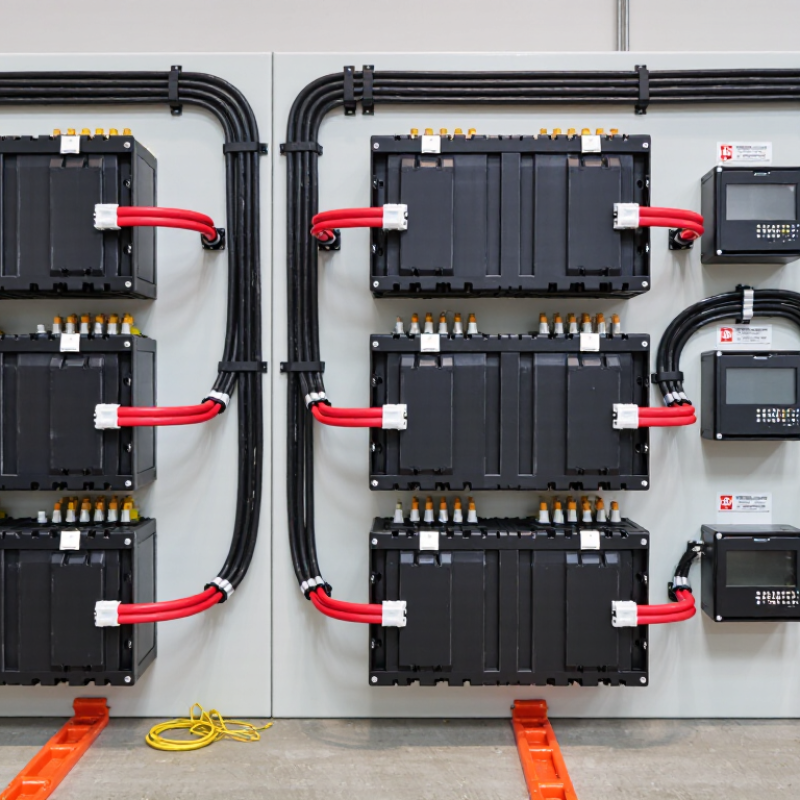
What Is a Wall-Mounted Battery Harness?
What Is a Wall-Mounted Battery Harness?
A wall-mounted battery harness is a purpose-built cable assembly connecting a home battery, inverter, and protection equipment. It carries DC power and control signals through organized, insulated conductors. Unlike loose cables, a harness uses fixed lengths, labeled ends, terminals, protective sleeving, and strain relief. It should fit the battery enclosure without sharp bends or pressure points.
This small assembly carries serious responsibility. The International Energy Agency reported that global battery-storage additions reached about 42 GW in 2023, more than doubling from the previous year. As installations grow, consistent harness design becomes increasingly important. A qualified manufacturer checks conductor size, temperature tolerance, connector locking force, insulation resistance, and polarity. Field technicians should also inspect crimp marks and measure voltage before energizing the system. Small errors matter.
Not every harness is interchangeable. Battery voltage, current, enclosure depth, connector type, and communication wiring must match the system design. The National Renewable Energy Laboratory’s Annual Technology Baseline continues to track falling battery-system costs, but cheaper equipment does not remove wiring risks. I have seen neat-looking cables fail when a terminal loosened under repeated heating. That detail is easy to miss. Manufacturers should provide traceable test records, clear labeling, and installation guidance aligned with applicable electrical standards. Still, documentation can be incomplete, so installers should verify every pin and torque value independently.
Key Criteria for Evaluating Battery Harness Manufacturers in 2026
Evaluating wall mounted battery harness manufacturers in 2026 requires more than checking price and delivery promises. The IEA’s Global EV Outlook 2024 reported global battery demand above 750 GWh in 2023, rising about 40% year on year. That growth increases pressure on harness suppliers. Buyers should inspect conductor sizing, insulation ratings, connector retention, bending performance, and documented thermal cycling results.
Traceability matters. Each harness should link to wire batches, crimp tooling, operator records, and electrical test results. Ask for pull-force data, resistance measurements, and samples from normal production, not only laboratory prototypes. IEC 60512 testing can support connector verification, while ISO 9001 systems indicate process discipline. They do not guarantee perfect workmanship.
Look closely at wall-mounted use. Harnesses may face tight bend radii, vibration, heat, moisture, and repeated service access. The IEA’s Batteries and Secure Energy Transitions report recorded roughly 42 GW of new battery storage capacity in 2023. This expansion makes field reliability increasingly important. A manufacturer should explain strain relief, fire-resistant materials, polarity controls, and end-of-line inspection.
A clean certificate file is not proof of every production lot. Ask for nonconformance rates and corrective-action records. Some suppliers resist that question. It remains essential. Factory audits, independent testing, and pilot installations provide stronger evidence than polished brochures. No scorecard is perfect. Recheck assumptions after six months of field data.
Leading Wall-Mounted Battery Harness Manufacturers of 2026
Leading Wall-Mounted Battery Harness Manufacturers of 2026
Wall-mounted battery systems are becoming more compact, modular, and installation-focused. The International Energy Agency’s Global EV Outlook 2025 reports continued growth in battery deployment, increasing demand for reliable power connections. Manufacturers now compete on more than copper content. They must control routing, insulation, connector fit, and service access.
Experienced harness producers typically design assemblies for 48-volt and higher-voltage storage platforms. They use documented crimp-force testing, insulation-resistance checks, and thermal cycling before shipment. A practical harness should fit behind a narrow enclosure without sharp bends. It should also include clear polarity labels and strain relief near the connector. The UL Energy Storage Systems and Equipment guidance emphasizes controlled construction and verification for battery-related equipment.
Traceability is becoming a purchasing requirement. The ISO 9001 quality framework supports controlled production records, inspection plans, and corrective actions. Strong manufacturers can identify wire lots, terminal batches, operator checks, and test results. This matters when a connector loosens after months of vibration or repeated maintenance.
Details still expose weaknesses.
Some suppliers publish impressive current ratings but provide limited derating data for warm cabinets. That gap deserves scrutiny. The IEA also highlights the importance of resilient, efficient energy infrastructure, yet harness specifications often remain vague about heat, humidity, and installation errors. Buyers should request dimensional drawings, bend-radius limits, pull-test results, and sample validation before approving large orders. A polished datasheet is not proof of field durability.
2026 Top Wall Mounted Battery Harness Manufacturers
Leading Wall-Mounted Battery Harness Manufacturers of 2026
This chart presents commonly used nominal battery-system voltage classes relevant to wall-mounted battery harness design. The values describe application requirements rather than individual companies or brands. Higher-voltage systems generally require stricter insulation, creepage, clearance, connector, and safety design controls.
Comparison of Product Quality, Safety, Customization, and Support
2026 Top Wall Mounted Battery Harness Manufacturers?
Comparison of Product Quality, Safety, Customization, and Support
In 2026, leading wall mounted battery harness manufacturers should prove quality beyond polished samples. Look for copper conductors, consistent crimping, firm terminals, and heat-resistant insulation. A reliable harness should fit neatly without sharp bends or loose loops. Small details matter.
Safety testing deserves close attention. Manufacturers should provide traceable material records, electrical test results, and clear assembly instructions. Check insulation resistance, voltage endurance, temperature rise, and connector locking strength. Harnesses should match the battery’s current, voltage, and installation environment. A beautiful cable can still fail under heat.
Customization separates capable suppliers from ordinary assemblers. Useful options include cable length, terminal type, labeling, branch layout, protective sleeving, and communication leads. Ask for drawings before production. Confirm every pin. One overlooked pinout can delay an entire installation. Support is equally important, especially during commissioning. Responsive engineers should answer wiring questions, review photos, and explain replacement procedures clearly. However, supplier promises are not enough. Request sample approval, inspection records, and a corrective-action process. Some evaluations focus too heavily on appearance; that is a mistake. Real reliability often hides inside the connector, where poor crimp pressure may remain invisible.
How to Choose the Right Battery Harness Manufacturer for Your Needs
Choosing the right wall-mounted battery harness manufacturer requires more than comparing prices.
The International Energy Agency’s Batteries and Secure Energy Transitions report recorded 42 GW of new battery storage capacity in 2023, nearly double the previous year. This growth increases pressure on harness suppliers to deliver stable performance, accurate assembly, and traceable materials.
Ask manufacturers for conductor sizing calculations, temperature-rise test results, and insulation specifications. A suitable harness should match the battery’s continuous current, peak load, voltage, and enclosure space.
Check terminal crimp quality, bend radius, locking strength, and resistance to vibration. Experience matters here. A supplier that understands wall-mounted installation can prevent routing problems before production begins.
Compliance with relevant IEC, UL, and IPC/WHMA-A-620 requirements also supports safer procurement. However, certificates alone are not enough. Ask for recent inspection records and sample reports.
Tips:
Request a small pilot batch first. Measure fit inside your actual enclosure. Test heating after sustained operation. Confirm lot traceability and replacement support.
Discuss custom lengths early; excessive slack creates pressure on connectors.
One overlooked detail is service access. A harness may pass laboratory testing yet remain awkward to disconnect on a wall. That practical weakness deserves honest review before mass production.